
Dyslexia is one of the most common learning differences, affecting up to 20% of the population. It impacts how children process written language, making reading, spelling, and writing more challenging. Despite its prevalence, dyslexia is often misunderstood, leading to unnecessary frustration for children and their families. In this blog post, we’ll explore what dyslexia is, how it affects children, and ways to support young learners on their journey to success.
What is Dyslexia?
Dyslexia is a neurodevelopmental condition that affects the brain’s ability to recognize and process the sounds in language, making it difficult to connect letters to their corresponding sounds. It is not related to intelligence, vision problems, or laziness. In fact, many children with dyslexia are highly creative, resourceful, and capable thinkers.
Dyslexia can range from mild to severe, with each child experiencing it uniquely. However, with early identification and the right support, children with dyslexia can learn to read and write effectively.
Signs and Symptoms of Dyslexia in Children
Dyslexia can look different in every child, but common signs include:
Preschool and Early Elementary School
• Difficulty learning the alphabet or recognizing letters.
• Trouble with rhyming or understanding how words break down into smaller sounds (phonemes).
• Challenges learning simple sight words like “the,” “and,” or “it.”
Elementary and Middle School
• Reading below grade level.
• Frequent spelling errors, such as mixing up letters (e.g., “b” and “d” or “p” and “q”).
• Taking an unusually long time to complete reading or writing assignments.
• Avoiding reading out loud due to fear of mistakes.
Emotional and Social Impact
• Frustration or anxiety related to schoolwork.
• Low self-esteem due to struggles in areas where peers excel.
• Reluctance to participate in activities involving reading or writing.
The Strengths of Children with Dyslexia
While dyslexia presents challenges, children with the condition often possess unique strengths, such as:
• Creativity: Many children with dyslexia excel in visual arts, music, and storytelling.
• Big-picture Thinking: They often see problems holistically and approach them in innovative ways.
• Resilience: Overcoming academic hurdles can foster determination and perseverance.
• Strong Verbal Skills: Some children with dyslexia excel in oral communication, excelling in areas like debate or public speaking.
How to Support a Child with Dyslexia
1. Early Identification and Intervention
If you suspect your child has dyslexia, seek an evaluation from a specialist. Early diagnosis is key to providing effective support.
2. Use Multisensory Learning Techniques
Programs that combine visual, auditory, and kinesthetic methods, like the Orton-Gillingham approach, are highly effective for teaching children with dyslexia.
3. Encourage Assistive Technology
Tools like audiobooks, text-to-speech software, and speech recognition programs can help children access content and express themselves more easily.
4. Provide Extra Time and Support
Children with dyslexia often need more time for reading and writing tasks. Ensure they have accommodations, such as extended test time, to reduce stress.
5. Celebrate Small Wins
Acknowledge and celebrate your child’s progress, no matter how small. This builds confidence and motivation.
6. Foster a Love of Reading
Read with your child regularly, focusing on enjoyment rather than perfection. Choose books that align with their interests, even if the text is simpler than their age level.
How Parents and Teachers Can Work Together
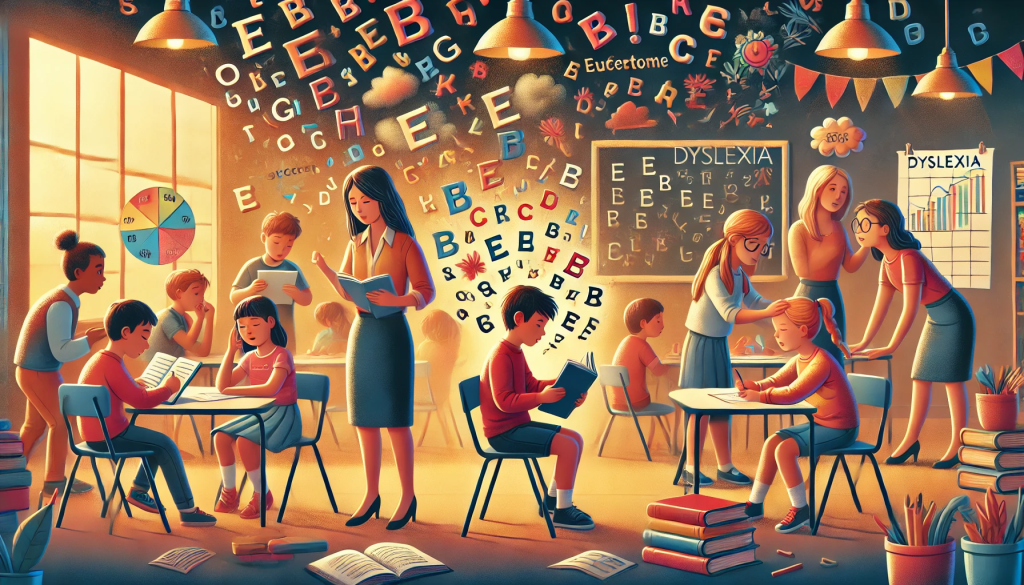
Close collaboration between parents and educators is essential for helping a child with dyslexia thrive. Teachers can provide classroom accommodations, like seating arrangements that minimize distractions or breaking tasks into smaller, more manageable steps. Parents can reinforce these strategies at home by creating a supportive environment for learning.
Building Confidence in Children with Dyslexia
One of the most significant challenges for children with dyslexia is maintaining their self-esteem. Help your child understand that dyslexia doesn’t define them—it’s just one part of who they are. Encourage their strengths and passions, and remind them of successful individuals with dyslexia, such as Albert Einstein, Richard Branson, and Steven Spielberg.
Final Thoughts
Dyslexia in children is not a limitation but a different way of learning and processing information. With the right tools, strategies, and encouragement, children with dyslexia can overcome challenges and unlock their full potential.
By fostering understanding and creating supportive environments, we can empower dyslexic children to succeed not only in school but in life. Let’s celebrate their unique abilities and embrace the beauty of neurodiversity.

 The Neurodiverse Society