(Especially Neurodivergent Homes)
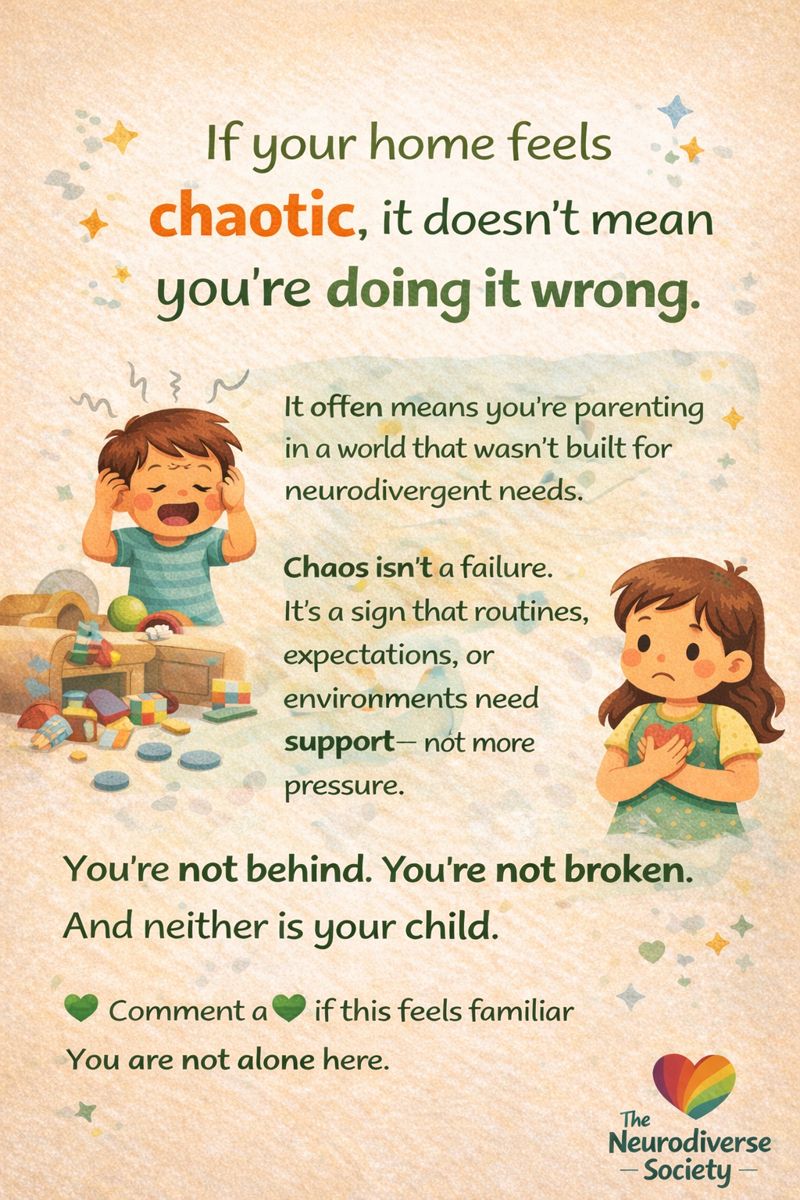
If your home feels chaotic, loud, unpredictable, or overwhelming, it doesn’t mean you’re doing something wrong.
For many families—especially those raising neurodivergent children—chaos isn’t a parenting failure. It’s a signal.
A signal that expectations don’t match needs.
A signal that nervous systems are overloaded.
A signal that support is missing—not effort.
Let’s talk about why chaos happens, why it shows up more often in neurodivergent homes, and what actually helps.
Chaos Isn’t Bad Behaviour — It’s Communication
When a child is melting down, refusing, yelling, or shutting down, they aren’t choosing chaos.
They’re telling us something they can’t yet explain with words.
In neurodivergent children, behaviour is often the result of:
- Sensory overload
- Difficulty with transitions
- Unclear expectations
- Emotional dysregulation
- Communication challenges
When the nervous system is overwhelmed, logic, reasoning, and “good behaviour” are not accessible.
Chaos is the body saying: “This is too much.”
Why Chaos Shows Up More in Neurodivergent Homes
Neurodivergent brains process the world differently. Sounds feel louder. Transitions feel harder. Unexpected changes feel threatening instead of neutral.
What looks like a “normal” day to others can feel like a constant state of alert for a neurodivergent child.
Common triggers include:
- Rushed mornings
- Changes in routine
- Too many verbal instructions
- Sensory-heavy environments
- High expectations without enough support
When these pile up, chaos becomes inevitable—not because of poor parenting, but because the environment isn’t regulated.
Routines Fail When They’re Rigid, Not Supportive
Many parents are told, “Just be consistent.”
But consistency without flexibility doesn’t create calm—it creates pressure.
Rigid routines don’t work for neurodivergent children because:
- Energy levels change daily
- Sensory tolerance fluctuates
- Development isn’t linear
When routines don’t allow for regulation, they fall apart—and parents blame themselves.
What actually helps is predictability with flexibility.
The Missing Piece: Regulation Before Behaviour
A child who isn’t regulated cannot:
- Follow instructions
- Transition smoothly
- Use coping strategies
- Communicate effectively
Expecting behaviour without regulation is like asking someone to run on a broken leg.
Calm doesn’t come from consequences.
Calm comes from safety, understanding, and support.
Why Visual Supports Matter So Much
Visual aids help bridge the gap between expectation and understanding.
They:
- Reduce verbal overload
- Make routines predictable
- Support independence
- Lower anxiety around transitions
For neurodivergent children, visuals often work better than words—especially during stress.
That’s why visual schedules, lanyards, and routine boards are so effective in chaotic homes.
Chaos Doesn’t Mean You’re Failing
If your home feels chaotic:
- You are not behind
- You are not broken
- Your child is not “too much”
You are parenting in a world that wasn’t built for neurodivergent needs—and that takes strength.
With the right tools, understanding, and support, chaos can soften into calm.
Ready to Move From Chaos to Calm?
You don’t have to figure this out alone.
Inside our Chaos to Calm Workshop, we break this down step by step:
- Why chaos shows up
- How to support regulation
- How to build routines that actually work
- How to use visuals and tools without overwhelm
💚 Chaos to Calm starts February 9
Designed for real families, real life, and real neurodivergent needs.
Final Reminder
Chaos is not a character flaw.
It’s a nervous system asking for support.
And support changes everything 💚

 The Neurodiverse Society