If you’ve ever followed parenting advice exactly as told—and still felt like things were falling apart—you’re not alone.
Many parents of neurodivergent children try everything they’re “supposed” to do:
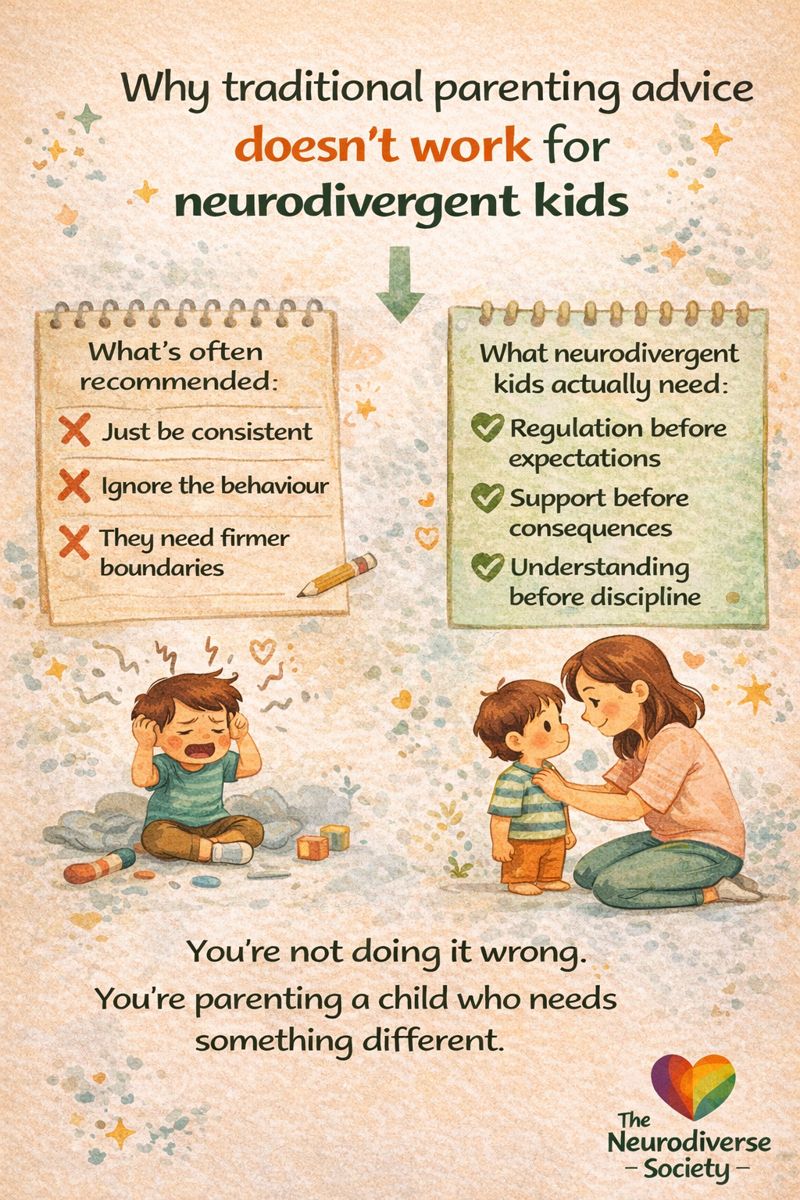
- Be consistent
- Follow through with consequences
- Ignore certain behaviours
- Use reward charts or punishments
And when it doesn’t work, the message they receive—directly or indirectly—is that they must be doing something wrong.
But here’s the truth:
Traditional parenting advice often doesn’t work for neurodivergent kids because it wasn’t designed for their brains.
Most Parenting Advice Is Built on Compliance, Not Regulation
Traditional parenting models are often built around one core assumption:
That children can meet expectations if they choose to.
This works (to some degree) for neurotypical children whose nervous systems can tolerate:
- Verbal instructions
- Delayed rewards
- Emotional discomfort
- Flexible transitions
But neurodivergent children aren’t refusing to comply—they’re often unable to access regulation in that moment.
Behaviour isn’t a choice when the nervous system is overwhelmed.
Neurodivergent Kids Experience the World Differently
Neurodivergent children (including autistic children, children with ADHD, sensory processing differences, speech delays, and more) process the world in a fundamentally different way.
Things that seem small to adults can feel overwhelming:
- Noise
- Transitions
- Unexpected changes
- Too many verbal instructions
- Sensory discomfort
When the nervous system is overloaded, the brain shifts into survival mode. In that state:
- Reasoning shuts down
- Emotional control disappears
- Learning stops
No amount of consequences can override a dysregulated nervous system.
Why “Just Be Consistent” Often Backfires
Consistency is one of the most common pieces of parenting advice—and one of the most misunderstood.
For neurodivergent children, rigid consistency can actually increase distress.
Why?
- Energy levels fluctuate daily
- Sensory tolerance changes moment to moment
- Development is not linear
Expecting the same response, behaviour, or capacity every day ignores what’s happening inside the child’s body and brain.
What neurodivergent kids need isn’t rigidity—it’s predictability with flexibility.
Punishment Doesn’t Teach Regulation
Punishment assumes a child has access to self-control and is choosing not to use it.
But when a child is dysregulated:
- They can’t “learn a lesson”
- They can’t reflect on behaviour
- They can’t access coping skills
Punishment may stop a behaviour temporarily, but it doesn’t teach:
- Emotional regulation
- Communication
- Problem-solving
In fact, it often increases fear, shame, and anxiety—making future meltdowns more likely.
What Neurodivergent Kids Actually Need
Instead of compliance-based strategies, neurodivergent children benefit from approaches that prioritize the nervous system first.
This includes:
- Regulation before expectations
- Support before consequences
- Understanding before discipline
When children feel safe, understood, and supported, behaviour improves naturally—because their nervous system is no longer in survival mode.
The Role of Visual Supports and Structure
One reason traditional advice fails is because it relies heavily on verbal instruction.
For many neurodivergent children, words alone are not enough—especially during stress.
Visual supports help by:
- Reducing verbal overload
- Making expectations clear
- Supporting transitions
- Increasing independence
Visual schedules, lanyards, and routine boards don’t “spoil” children—they support their brains.
You’re Not Doing It Wrong
If traditional parenting advice hasn’t worked for your family, it doesn’t mean you’ve failed.
It means:
- Your child needs something different
- Your family needs tools designed for neurodivergent needs
- The advice didn’t fit your reality
Parenting a neurodivergent child requires different strategies, not more effort.
Moving From Chaos to Calm
When parents shift from control-based strategies to regulation-based support, something powerful happens:
- Meltdowns soften
- Transitions improve
- Communication increases
- Parents feel more confident and less overwhelmed
This is exactly what we focus on inside our Chaos to Calm Workshop—a practical, supportive program designed for real neurodivergent families and real life.
💚 Chaos to Calm starts February 9
Step-by-step support, visuals, routines, and strategies that actually work.
Final Thought
Your child isn’t broken.
You aren’t failing.
And you don’t need harsher strategies—you need better ones.
Support changes everything 💚

 The Neurodiverse Society